Room to grow, without the lease.

The practical business storage guide

Stock, records, equipment and the things between premises. A look at what businesses store, what the law makes you keep, and how to take space by the month.

The commitment

Two kinds of space.
One business.

Commercial premises and storage are not priced the same way, and they are not committed to the same way either. The difference that matters is how long you are tied in.

01 / Warehouse or office lease3–5
years

A typical commercial lease term, with a deposit and a fixed monthly cost whether you fill the space or not.

02 / Storage2
weeks

Cape Storit rental runs month to month with two weeks’ notice, and no deposit at any site.

The question is not what space costs. It is what happens if you are wrong.

Businesses outgrow, shrink and change premises faster than a lease can follow.

What goes in

Stock, records and the things between jobs.

Four things turn up again and again when small businesses ask us for space.

Stock you cannot keep at home

Seasonal lines, bulk buys and the inventory an online shop needs somewhere to live.

Records you are not allowed to throw away

Tax and company records carry retention periods set by law — see section 04.

Equipment between jobs

Tools, staging, event kit and trade equipment that is idle between contracts.

A whole office, briefly

Desks and filing while you move premises, renovate, or downsize to hybrid.

A small business owner working among stock and boxes in storage

When the space runs out

Outgrowing the unit
you are already in.

Cape Town is the tightest commercial market in the country, so the space you want next is not always there when you need it.

Growing faster than the lease

Take another pod or unit this month rather than renegotiating premises you signed for years.

Between premises

Somewhere for everything to sit while one lease ends and the next one starts.

Going hybrid

Fewer desks, same filing. Keep what you still need without paying office rates for it.

2.7%Cape Town decentralised office vacancy — the lowest of any South African metro
12.1%The national office vacancy rate, for comparison
R85–135Per m², per month, for Cape Town warehouse space in 2026

SAPOA Q2 2026 vacancy figures and 2026 industrial lease benchmarks — see Sources.

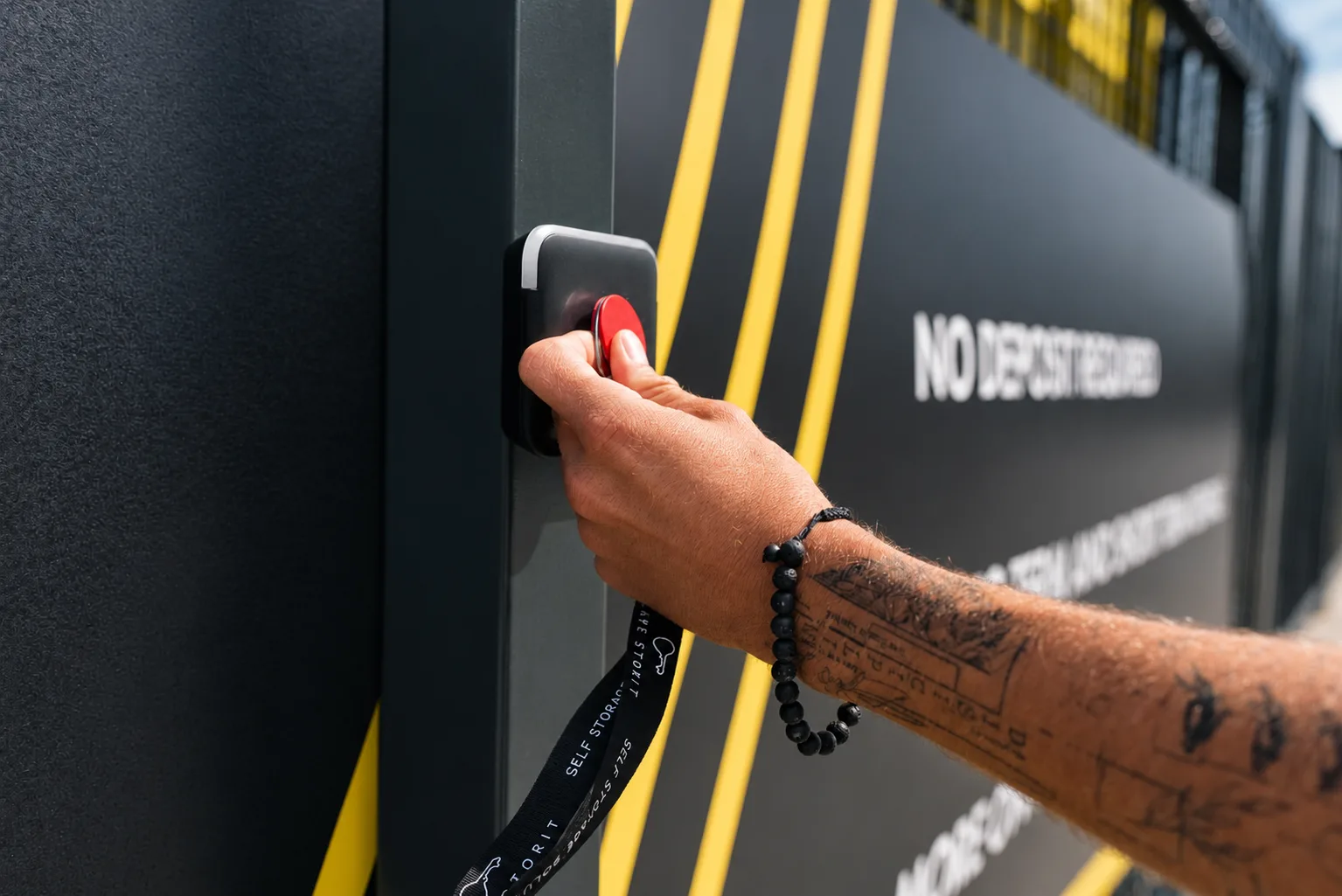
A hand at the access keypad of a Cape Storit facility
The paperwork

The records you
cannot throw away.

Two different Acts set two different clocks running on your paperwork, and they do not expire at the same time.

5 yearsSARS — from the date the return was submitted, not the date of the transaction
7 yearsCompanies Act — accounting records and annual financial statements

Different Acts, different periods. The practical rule is to work to the longest one that applies to a document.

Your plan

What to do, and when.

A short sequence that keeps the space decision ahead of the lease decision.

01 / THIS WEEK

Separate the two piles

What the business uses weekly, and what it merely has to keep. Only the second pile belongs in storage.

02 / BEFORE YOU SIGN

Price the overflow separately

Work out what you would pay to store the dead stock and archives, then see how much smaller the premises can be.

03 / MOVING IN

Index as you pack

Label by month and category. A box you cannot find is a box you will buy again.

04 / EVERY YEAR

Clear what has aged out

Once records pass their retention period they are cost, not compliance.

Two ways to do it

Storage that fits
how your business works.

Keep your own key and come and go, or have pods collected and returned when you need them.

Drive-up self storage units at a Cape Storit site

Self storage

  • Your own unit, your own key
  • Drive up and load directly
  • Paarden Eiland, Parow and Woodstock
Explore self storage ↗
A Cape Storit wooden storage pod being loaded

Valet storage pods

  • We bring the pod to you and take it away
  • From R750 per pod, per month
  • Stored indoors at our Maitland warehouse
Explore valet storage ↗

Customer experience

People who have
made the move.

From people who stored with us.

G★★★★★ 4.8 from 144 Google reviews

★★★★★

The easiest and quickest move in I’ve ever had!! The staff are incredible, so helpful and sweet and the move in process was as easy as can be!

JJustine BrinkPaarden Eiland · Review on Google

★★★★★

They came to my house and assisted in loading the units and transporting them to their facilities, very easy and convenient. They are easy to communicate with and give great service.

MMoneen BooyseJohannesburg · Review on Google

★★★★★

...the pod access and availability to wait after hrs during my move on Sat 29 Aug... was truly appreciated. The cost was also way more reasonable than other storage places.

CColette ApollesMaitland · Review on Google

★★★★★

The whole process, from booking to moving my things in, was easy and straightforward. The facility feels secure, and access has always been hassle-free.

SSelina EichelbrönnerMaitland · Review on Google

★★★★★

My son is studying in Cape Town and he moved out of a student house at the end of November, and we had to store his things until we found him a new place in February... their rates were considerably lower than other places I requested quotes from.

SSonne GerberMaitland · Review on Google

★★★★★

Since my first interaction with Ameerah, she made sure my storage unit was booked immediately and maintained clear communication until I moved in. The access is simple and secure—highly recommended!

OOdile FransmanWoodstock · Review on Google

Business Storage: Common Questions

How much space does a small business need?

It depends entirely on what is going in. As a rough guide, a pod holds six cubic metres — about the contents of a small one-bedroom flat, or a few pallets worth of boxed stock. Send us photographs of what you need to store, or use the storage calculator, and we will size it before you pay anything.

Do I have to sign a long lease?

No. Rental is month to month with two weeks’ notice. That is the main practical difference between storage and commercial premises: you can be wrong about how much space you need, and about how long you need it, without it costing you years.

Is there a deposit?

No. Cape Storit does not take a deposit at any of our sites. You pay your first month’s rental, sign the storage contract, and move in.

What does it cost?

Valet pods are R750 per pod, per month. Drive-up self-storage units are priced by size and by site — ask us and we will quote on the size you actually need rather than the one you guessed at.

Can I get to my stock during the week?

Yes. A drive-up unit is yours to visit during your site’s access hours. If your goods are in valet pods at the Maitland warehouse, give us notice and we will have your pod at the front ready for you.

Can I take more space as the business grows?

Yes — take another pod, or a second unit, subject to availability at the site. You pay per pod per month, so the cost follows what you are actually using.

How long do I legally have to keep business records?

Records supporting a tax return must be kept for five years from the date the return was submitted, under the Tax Administration Act. Company accounting records and annual financial statements must be kept for seven years under the Companies Act. Where both apply, work to the longer period. This is a general summary, not tax advice — check with your accountant.

Are my goods insured?

Cape Storit does not provide insurance coverage for the goods stored inside your unit. While we insure the storage facility itself, it is your responsibility to obtain insurance coverage for your stored belongings. We highly recommend that you secure insurance coverage to protect your goods against potential risks or damage. Please consult with your insurance provider to explore suitable options for insuring your stored items.

What can’t I store?

Hazardous, illegal and perishable items are not allowed. If you are unsure whether something in your inventory qualifies, ask us before you book.

What happens if my dates move?

Tell us and we will move the booking. Premises deals and handovers slip for reasons nobody controls.

In more detail

The long version.

What the numbers actually say about commercial space in Cape Town, online retail, and how long the law makes you keep things.

Why storage is not just cheaper premises

The per-square-metre comparison does not work

It is tempting to compare storage to warehouse rent per square metre. Do it honestly and storage loses. Cape Town warehouse space ran roughly R85 to R95 per m² a month in the stronger industrial nodes in 2026, reaching about R135 in prime buildings. A Cape Storit pod holds six cubic metres on a floor area of about three square metres, at R750 a month — call it R250 per m². On that measure alone, warehouse space is the cheaper square metre.

Worth saying plainly: per square metre, storage costs more than a warehouse. It is the wrong comparison, but pretending otherwise would be dishonest.

What you actually cannot buy

The catch is that nobody leases you three square metres. Industrial space is let in units, and the smallest of them are far larger than the overflow most small businesses are trying to solve — on a lease measured in years, with a deposit, rates and a fit-out. You are not choosing between R90 and R250 per m². You are choosing between a few square metres by the month and a few hundred for three to five years.

The useful question is not what a square metre costs. It is how few of them you can get away with renting.

The Cape Town squeeze

There is very little slack in this market

SAPOA put Cape Town’s decentralised office vacancy at 2.7% in the second quarter of 2026 — the lowest of any metro, and below where it sat before the pandemic. Nationally the figure was 12.1%. Industrial vacancy in the well-located Cape Town nodes is tighter still.

What that means for a growing business

It means the unit next door is probably not available, and the bigger premises you would move to may not be either. Businesses in this market tend to solve growth by taking space somewhere else rather than by moving — which is precisely the shape of problem storage is good at.

Stock without a shop

Online retail is now a tenth of the market

World Wide Worx and Mastercard put South African online retail at about R159-billion in 2026, roughly 10% of total retail turnover, growing 22.5% against about 4% for retail as a whole. A decade ago it was under 1%.

The practical consequence is a large number of businesses holding real inventory without a shop to hold it in. A spare room works until it does not, and the point at which it stops working usually arrives in the middle of a good month.

How long you must keep records

Two Acts, two clocks

The Tax Administration Act requires records that support a return to be kept for five years, and the five years runs from the date the return was submitted — not from the date of the transaction. The Companies Act requires company accounting records and annual financial statements to be kept for seven years.

The practical rule

Where both apply, work to the longer one. Most accountants land on seven years as the safe default for anything financial. That is a meaningful volume of paper for a business that has been trading a while, and none of it needs to sit in the office.

This is a general summary, not legal or tax advice. Retention periods vary by document type and other Acts may apply to your industry — check with your accountant.

References

Sources

Figures were correct at the time of writing, September 2026. Rentals vary by node, building and lease term. Nothing here is legal, tax or financial advice — speak to your accountant about your own records.

Ready when your business is

Take the space,
not the lease.

Tell us what you need to store and for roughly how long. We’ll help you size it before you pay anything.

Chat about your business ↗Or work out the space with the storage calculator.